Two Conversations

I think couples in conflict often engage in two conversations.  One is overt, constantly repeated and endlessly frustrating.  The other is almost always unsaid – and unacknowledged.  If we can get to that second conversation, we can find the peace and connection we so desperately need in our intimate relationships.  Instead, we get all tangled up in the conversation that doesn’t go anywhere. Like birds flitting back and forth above us, what we see is that which transfixes us and grabs our attention.  I have seen it over and over again in my office – the sad, ever-so-discouraging dance of the upper conversation that almost guarantees that both people will just….feel….bad and not feel heard by the other.  This conversation is always about something.  “You don’t help around the house …..I do too help.  What about last week when you were tired and I vacuumed downstairs…..Oh great, thanks a lot – am I supposed to bow down because you vacuumed once?”   “How come you aren’t even trying to go back to work to bring in some money?…..I have tried.  You just don’t know what it’s like out there….You aren’t doing nearly enough….You have no idea what I have done.”  These conversations don’t go anywhere because they aren’t’ about what’s really going on inside for each person.

The real conversation – the one that can get somewhere – is the attachment conversation.  It is about our needs that are deep and tug at our hearts.  These are also needs that can be satisfied once there is a safe way to express them.  They can be the need to feel truly cared for – or to feel competent and valued – or to know your partner is not going anywhere.  They are almost always about the need to be actually seen and still loved and accepted.  This most critical and meaningful conversation can be very difficult to have without the help of a relationship professional.  My bias (and observation) is that Emotionally Focused Couples Therapy is a wonderful platform upon which these “conversations for connection,” in Sue Johnson’s words, can occur.

He/She Said THAT??

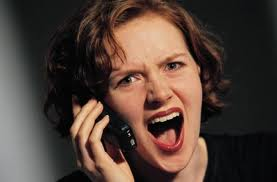
I hear it so often in my office.  One partner or the other (usually both) will report that in the height of some nasty fight they escalated into, one of them said something so wounding that the target is still bruised.  He or she struggles with how to make sense of a world where they are supposed to be working on their relationship and at the same time things are said which couldn’t feel more destructive.  It’s heartbreaking to see the pain that good people can inflict on one another when they have escalated to the outer reaches of their own cycle.   It is an inescapable fact that when two people are reacting to each other from the raw and vulnerable places inside – and they are swept up in their cycle of fear, anger and reactivity, they can spin so fast (almost instantaneously) that both feel out of control.   It is for sure that these deeply hurtful statements aren’t made during a placid dinner conversation right after, “Please pass the peas.”  These missiles that are launched almost always occur when the cycle is spinning so fast, that the centrifugal force of both people’s emotional reactivity throws them to the extreme edge of their experience.  So, rather than mull on the thing said, it’s far more helpful to view the statements as symptomatic of a cycle that has gone from “zero to 60” in a nanosceond.  The path to healing is to begin to find ways to catch ourselves at the very beginning stages of this emotionally reactive cycle – to slow it down at the outset and step out of this tightly choreographed automatic dance.

Discernment Counseling – For Couples “On the Brink”

William Doherty is a nationally recognized authority in marital therapy who has written a host of really helpful books – my favorite being Take Back Your MarriageDoherty came to speak to the annual conference of the Washington Association of Marriage and Family Therapy on 3/3 and introduced a room full of raptly attentive marital therapists to Discernment Counseling.  “How do we deal with the couple,” Doherty asks, “where one partner is leaning into the marriage and the other is leaning out?”  To attempt conventional marital therapy in such situations is an invitation to disappointment on everyone’s part.  So Doherty has devised a powerful approach in which he works mostly separately with each partner.  The referral often comes from divorce lawyers and in situations in which the “leaning out” partner is feeling done, but is willing to at least speak to someone because some ambivalence (if even ever-so-slight) remains.  The partners agree that divorce will be off the table for six months as they work to see if reconciliation is even possible.  The benefit of this kind of work is that that therapist can have open and very candid conversations with each person about the consequences of divorce; their own role in bringing the marriage to its current state and whether each is willing to make an all out effort to see if the marriage can be brought back.  Studies have shown that of divorcing couples, fully 30% have at least one partner who is ambivalent and in 10%, both parties are.  For more information, you can check out Doherty’s Couples on the Brink website.

In the Grip of the Cycle

It’s hard to adequately describe the poignancy and pain of people who are locked into a chronic, demoralizing, soul-sapping cycle of conflict in their intimate relationships. John Gottman observed that couples enter relationship counseling, on average, after they have experienced serious problems for six years. That’s a lot of painful grinding on each other. No wonder the couples we help in couples therapy start out so painfully estranged that they are all but hopeless when they sit in our offices for the first time. And yet, I have no doubt – none – that unions that are challenged, with wrenching conflict, can be healed, set right and made stable for good. It doesn’t happen overnight and so people who engage this process need to be patient, courageous and kind to themselves. The first step, as Dr. Sue Johnson describes in her brilliant work setting out the approach of Emotionally Focused Therapy is to recognize and then get control of the cycle of conflict that is sparked automatically with distressed couples. It is amazing to be in the room with people who go from zero to 100 mph (emotionally speaking) in a millisecond. To witness this instantaneous transition is to respect forever more the power of the amygdala and emotional circuits of the brain. Time and again, I see this sad and painful drama spark in my office – one partner will say or do (or not say or do) something that will have deep attachment significance to the other and the reaction will be instantaneous and explosive. Both people are swept up into an agonizing dance. Each is reacting to the other – and reacting from a deep, frightened, exquisitely human place within. To the outside world – and to their partner – this pain is seen as anger, judgment, withdrawal, defensiveness – so many things that make it hard to reach out and provide the comfort, assurance and safety that both people hunger for at their core (especially when the connection with their partner seems shaky). The first step in good relationship therapy is de-escalation of conflict. Understanding those triggers that sweep each of us, instantaneously, into this cycle is the first step. It doesn’t happen overnight, but the relief it brings is as palpable as the heat generated by the conflict.

Reaching Out – The Power of Repair

All relationships have conflict. We will wound each other, often withtout even realizing the depth of the hurts we inflict. When our partner protests, often with anger, we recoil and defend ourselves. We think, “You’re saying I’m a bad person. You’re wrong and here’s why.” We so want to protect ourselves from the bad feelings that arise when our partner protests, that we can’t hear their own pain through their anger……and so it goes, until each of us reacts to the other’s anger or withdrawal, distancing ourselves further from the one person who can provide us safety and care. How can we slow and reverse this distancing? Many suggest that it is through the power of Repair. What is Repair? One way of thinking about it is that Repair is the word, act or touch that says, “I don’t like what’s happening to us, here. I don’t want to be hurt, angry or distant.” It can be stated in those simple words. It can also be the soft touch of concliation or gesture that moves towards the lover rather than away (helping with a task; making a cup of tea; giving a small, but thoughtful gift). It can be with humor. It can be with an admission of our part in the painful exchange. A colleague, and therapist trained in Gottman’s work suggested to me that the most powerful of John Gottman’s ideas is the power of repair. This is a useful idea in this time of gift giving.

Emotionally Focused Couples Therapy

John Gottman, Ph.D. has observed that when couples come in for their first appointment with a marital therapist, their relationship has had serious problems for, on average, six years.  I often tell couples that it is rare that two people will sit across me me and say something like, “We’re basically doing fine.  We just need some help with communication.”  Much more likely, I am sitting with two very wounded people, their feelings rubbed raw from years of conflict, pain and emotional distance.  Dr. Sue Johnson observed years ago that the intensity of the conflict – the very sense of being out of control – is tragically understandable – as each person’s deepest need for connection has been unmet.  This “attachment” need (see earlier posts) is so deep it is felt, literally, on a cellular level.  People are just so emotionally exhausted and strained when they first enter marital therapy that any therapist who blames either person, rather than compassionately trying to understand the particular wounds and needs of each is doing more harm than good.  Emotionally Focused Therapy, among many things, is like a balm to people’s psychic sores.   I am on the EFT community’s list serve and I am frequently moved by the deep care and compassion of these attachment therapists.  It is a pure and fine form of therapy.  The abiding belief of this community is that healing of even the most strained relationships can come to us if we are patient and give care rather than judgment.

The Four Horsemen

Relationship conflict isn’t a bad thing –  to be avoided whenever possible.   Ask any couple who’s been together for years and years and they will tell you that their time together has not been without conflict.  As U.W.’s John Gottman assures us, the problem isn’t conflict, it’s the way we deal with conflict.  According to Gottman 69%  of marital disagreements are durable.  We’ll never get them to agree with our view and we’ll certainly never agree with theirs.  Think of it….69%.  If we really think that the way to end this particular conflict is for one of us to come over to the other’s side, that’s a heck of a lot of frustration we’ll be dealing with.  So what happens when we are grinding on each other without a sense of resolution?  Well, the risk to our relationships, again, isn’t the fact of those perpetual disagreements.  It’s our tendency to slip into one, or more, of the negative relationship habits that Gottman terms The Four Horsemen of relationship apocalypse.  These are Criticism, Contempt, Defensiveness and Stonewalling.   Criticism:  When you don’t just have a complaint about something your partner did or didn’t do, but you criticize their character.  It’s not, “I’m really angry that you promised to take out the garbage but didn’t and it didn’t get picked up.”  It’s, “You always do this.  You are unreliable (or lazy or uncaring or selfish, etc.).  Contempt:  When you begin to nurture an attitude that you are superior to your partner.   Gottman observes that contempt is incredibly toxic for a relationship and if it is allowed free rein inside a person’s psyche, he can almost guarantee divorce.  Stonewalling:  When one partner shuts down and refuses to engage.  It may be the result of emotional flooding that feels overwhelming, but the period for that is fairly limited and the stonewaller shuts down and doesn’t re-engage.  It leaves the other person hanging out there, exposed.  The  stonewaller thinks their behavior is passive and doesn’t understand that it is experienced, usually, as much more painful and aggressive by their partner.  Finally, Defensiveness:  No matter what I say to you about my concerns, you have a reason, defense or counterattack.  I feel unheard and unacknowledged.  It is a terribly frustrating and painful experience and will cause me to withdraw to protect myself from feeling so invisible.  There are definitely ways to manage perpetual conflict, or conflict on topics that forever seem to defy solution, and these will be brought up in a later post.  For now, however, the point is that we need to be ever vigilant for the introduction of any of  The Four Horsemen into our relationship when we experience the emotional fatigue and discouragement of disagreements that seem not to have ready solutions.

Labelling People – Thinking About Narcissistic Personality Disorder

Recently, the New York Times reported that the mental health diagnostic “bible,” the DSM is going to drop Narcissistic Personality Disorder in its 5th Edition.   Laura Smith, Ph.D. provides a good explanation for why this was done, here.  While an interesting development in its own right, the move brings to mind an overriding concern about the easy use of labels like “narcissistic.”  Many, many, times have I heard people in recent years label someone as “narcissistic.”   It’s not that “people who believe the world only exists if seen through their own eyes” don’t exist – and it’s not that these folks don’t cause a lot of distress to those close to them. (I remember hearing in my training that the only way you see a person with NPD in therapy is if their spouse or family basically says, “Get help on this or we’re outta here!”)  San Diego mediator Bill Eddy identifies people struggling with NPD as one of a handful of “high conflict personalities” who challenge helping professionals mightily.  But here’s the problem – it’s easy to label, isolate and dismiss another person, losing sight of the fact that this rigid shell of a personality they present to the world covers enormous, old pain.   Eddy has suggested that the 4 major “high conflict personalities” at their core, are protecting themselves from the pain of early, constant violations to their developing, tender personalities.  The “borderline” personality is driven by the Fear of (emotional) Abandonment, suffered so early.  The “antisocial” personality is driven by the Fear of Being Dominated.  The “histrionic” personality is driven by the Fear of Being Ignored.   The “narcissistic personality” is driven by the Fear of Inferiority.  In fact, these people with hugely (over)inflated views of themselves have buried within their hearts a glass shard of failure to measure up – of not being good enough.  When we almost cavalierly label others as “narcissists” (or any other thing) we rob them of their humanity and pain.  Of course,  in their striving to protect themselves from the ancient, overwhelming wounds that are long-buried within,  they may often overwhelm and deeply injure their intimates.  But as with all injuries which we suffer at the hands of others, our own healing comes in part through our own halting efforts to understand and even hold compassion for the other. It’s not necessary to label the other so that we don’t take on responsibility for our own injuries.  It was never our fault anyway.  To humanize ourselves without dehumanizing the person who wounded us is an ongoing challenge and, I think, righteous goal.

Couples Therapy – What to Look For

John Gottman has observed that, on average, couples come in for counseling after they have been experiencing serious problems in their relationship for 6 years.  That means that when you sit in that client’s chair for the first time, you probably will be feeling angry, hurt and hopeless.  You will probably feel blamed by your partner.  You may be trying desperately to save your relationship – or you may be almost out the door and have agreed to give this one more shot.  You might have had a horrible fight recently that leaves both partners exhausted and wounded.  So now I’m going to share a prejudice of mine: People who seek the help of a therapist for couples work should see someone who is specifically trained to work with couples.  A therapist who is really good at working with individuals, may not be so helpful with couples.  Teaching communication skills can be very useful, for sure, but every couple brings with them a rich and complex dynamic.  It is this dynamic (or system….or cycle) that a therapist needs to understand and touch.  When we are stressed in our relationship we already feel alone and isolated.  Working with couples from an individual perspective only strengthens this sense of isolation, I think.  There are a number of wonderful ways to think about, and work with, couples in distress.  Many like Susan Johnson’s Emotionally Focused Couples Therapy.  Others develop an expertise in John Gottman’s approach.  Still others use Brent Atkinson’s Emotionally Intelligent Couples Therapy approach, or Dan Wile’s Collaborative Couples Therapy.  I prefer Johnson’s work, spiced by the work of these other exceptional and gifted people.  There are certainly more kinds of couples therapy out there.  My suggestion is that whoever you work with, make sure they have specific training and focus in an approach to couples therapy.

Attachment – The Tie That Truly Binds

Two lovers come into the therapist’s office, raw and wounded from months, or years, of painful conflict.  Perhaps they are in their seventh year of marriage.   Maybe they’ve been together 20 years.  (Marriage expert John Gottman says that the two peaks for divorce are in the first 7 years of marriage or in the 16-20 year range.)   Whatever their time together, there is one thing that most of these very sad and stressed couples have in common:  Their relationship shares the basic need for Attachment that this mother and child display .   What is “attachment?”   As John Bowlby first explained to us, attachment is a fundamental need for connection with another.  It is as biologically driven as food.  Children deprived of a safe, secure bond with a caregiver (usually the mother, but not always) will suffer dearly.  This need doesn’t go away just because we grow hair under our arms.   It prevails throughout life.   Attachment for a one year old means a secure base.  Touch mom.  Know she’s there.  Then explore your world.  Without that base, life is overwhelming and the child is lost.  Attachment means a safe haven.   When life threatens, our attachment figure is where we turn for security.  If you think this is just about babies ask yourself: Have I been more productive and comfortable in the world as an adult when I was in a secure relationship (if you have been so fortunate)?  Ask as well:  Who did adults call on their cell phones when the airliners slammed into the Twin Towers on 9/11?  Their husbands/wives/partners/closest friends…first call was to attachment figures.  The godmother of adult attachment theory and how it affects our intimate relationships is Dr. Sue Johnson.  Her approach to marital therapy for these desperately struggling people who are bonded, yet alienated, is Emotionally Focused Therapy.  Her book  Hold Me Tight is a guiding light for couples seeking reconnection.